Liquid-type formulation
Explore product form alongside its intended use.

BIOSTIMULATION · LIQUID PCL
Beginning with polycaprolactone. Aestyve Liquid PCL is positioned around skin quality—elasticity, texture and radiance. Explore its formulation concept and the research behind the material.
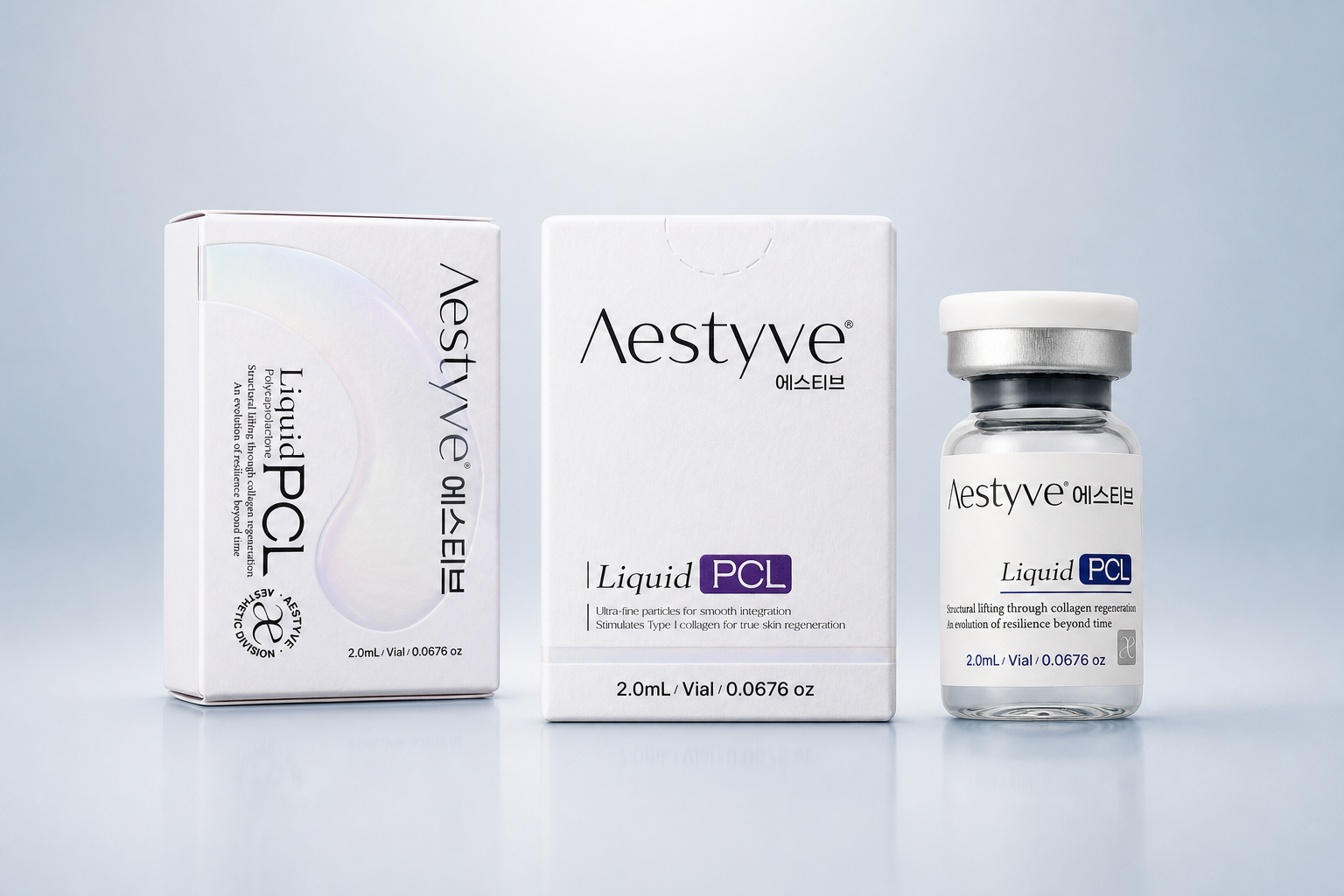
Brand-provided product image · refer to the supplied product labeling for pack configuration
Understand Liquid PCL through four perspectives: formulation, material, skin structure and evidence.
Explore product form alongside its intended use.
Begin with polycaprolactone as a material.
A product direction centered on elasticity, texture and radiance.
Distinguish material literature from supplied-product documentation.
01 / FORMULATION & MATERIAL
The brand describes a liquid-type formulation using ultra-fine particles. Particle presence, size and finished-product properties require product-specific documentation.

The brand describes a formulation with a liquid-like feel. Confirm the particle-size distribution and concentration in current specifications.
Studies have examined collagen formation with PCL-based formulations. Research on other formulations is not a substitute for Aestyve product data.
The product positioning centers on elasticity, texture and radiance. It does not guarantee a particular improvement or duration.
Suitability is assessed by a qualified clinician using the authorized indication, IFU and individual skin condition.
Very small particles are not the same as no particles. Visual clarity alone does not establish particle size or uniform tissue distribution. This page follows the brand-provided ultra-fine-particle description and distinguishes it from particle-free PCL research.
Explore the material and skin structure visually. Select a perspective to change the explanation.
A liquid-type description and particle size are different information. Confirm actual size distribution, concentration and uniformity in product-specific specifications.
The dermis comprises cells and extracellular matrix, including collagen. This illustration explains structure; it does not depict a change after product administration.
PCL publications differ in formulation and study population. Material research does not replace product-specific clinical evidence; applicability must be assessed separately.
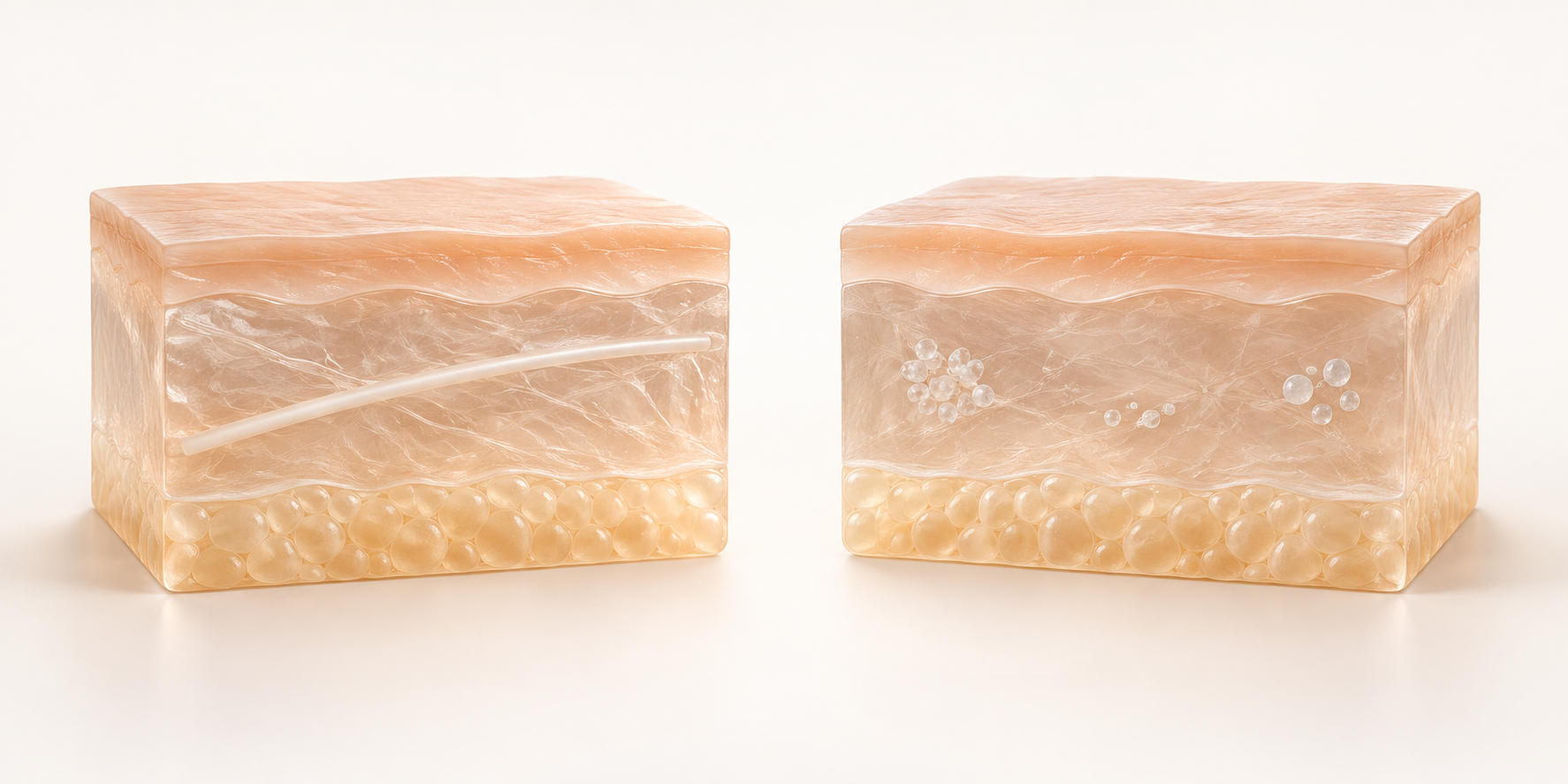
Concept visualization · not actual particle size, injection placement, tissue distribution or a before-and-after comparison.
Connect the product overview to your procurement review, step by step.
02 / LIQUID vs THREAD
The material name PCL does not make products equivalent in mechanism or outcome.
| Item | PCL lifting thread | Aestyve Liquid PCL |
|---|---|---|
| Form | Solid thread; structure varies by product | Brand-described ultra-fine-particle liquid |
| Approach | Tissue support according to thread design and placement | Collagen- and skin-quality-oriented positioning |
| Tissue response | Varies with material, structure, location and assessment time | Requires formulation, concentration, distribution and product evidence |
| Use criteria | Authorization and IFU of the specific thread | Authorization and IFU of the supplied product |
A comparison of form and review criteria, not clinical superiority or equivalence.
03 / LITERATURE
These four papers examine PCL materials, other formulations and threads. They do not report Aestyve Liquid PCL clinical outcomes.
Clin Cosmet Investig Dermatol. 13:31–48.
A review of PCL biodegradation and its use as a collagen-stimulating material in aesthetics.
View publication ↗J Cosmet Laser Ther. 17(2):99–101.
A two-patient pilot study examined tissue 13 months after injection of another PCL-based filler and observed collagen around particles.
View publication ↗Dermatol Ther. 34(2):e14770.
Evaluates safety, degradation and neocollagenesis of a particle-free PCL formulation in rats. Its technology differs from this product’s ultra-fine-particle description.
View publication ↗J Cosmet Dermatol. 20(9):2743–2749.
Compares PCL and other thread materials in mice. Tissue changes around threads cannot be transferred into efficacy figures for a liquid product.
View publication ↗04 / PRODUCT DOSSIER
Core information to verify against the current supplied-product documentation.
05 / BUYER FAQ
Review material literature separately from product-specific tests and clinical data. The supplied product’s authorized use and current IFU take priority; outcomes and duration can vary by individual and treatment conditions.
Share your target country, company or clinic, quantity and timing. Availability, quotations and sample terms are confirmed individually.
Start with current specifications, labeling and IFU, then ask about registration and batch-test documentation required for your market. Check that each document applies to the actual product and lot.
Review target-market registration, import requirements and distribution qualifications. Publication of this page does not establish authorization to sell in a particular country.
06 / START A CONVERSATION
Share your country, quantity and timing to define the next steps.
Product · clinic · distribution inquiries
Polycaprolactone · 2.0 mL / Vial
Manufacturing-document scope is reviewed against the supplied product’s label, lot and expiry. Manufacturing information is provided on a product-specific basis.
Request specifications, labeling / IFU, applicable finished-product CoA and registration documents. Document availability is confirmed for the product and destination market.
Tell us your destination country and importing entity. Availability is confirmed after review of product-specific registration and import requirements.
Displayed specifications follow brand-provided information. Verify the current supply label and specifications when ordering.
We review raw-material and finished-product documentation according to the product’s characteristics and applicable specifications.
Material identity, composition, concentration, pH and product-specific physical specifications
Applicable sterility or microbial, endotoxin and residual-substance test parameters
Lot number, expiry, fill volume, package integrity and storage conditions
For PCL products, we review composition, concentration, particle-size distribution and formulation uniformity against product specifications.
We publish certifications and test values only when valid supporting documents have been verified for the relevant product, model, manufacturing site or lot. We check the issuer, issue date and scope, and distinguish raw-material results from finished-product results.
These are product-specific review criteria, not a statement that every product has completed every test or holds a certification.
Review product specifications and required documents, then start your next sourcing conversation.
Request Product Dossier ↗